

De Rome à Cotonou, l’émergence du Groupe ACP
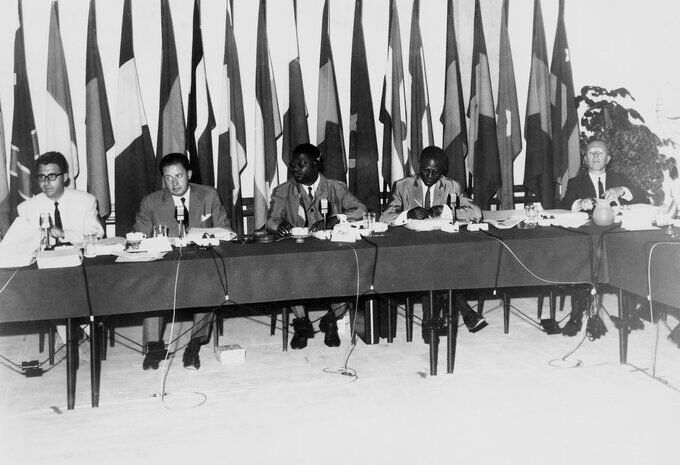
Réunion annuelle de la Conférence Parlementaire de l’Association entre la Communauté économique européenne et les États africains et malgache associés, à Abidjan, Côte d’Ivoire, le 10 Décembre 1966. Annual Meeting of the Parliamentary Conference of the Association between the European Economic Community and the Associated African States and Madagascar, in Abidjan, Ivory Coast, December 10, 1966.
Fondée en 1975 avec la Convention de Lomé, l’OEACP tire ses origines du Traité de Rome de 1957, liant la CEE aux colonies. Sous l’impulsion de Senghor et Houphouët-Boigny, elle s’élargit avec les Conventions de Yaoundé et Lomé, intégrant le Commonwealth. Ce 1er épisode raconte son évolution jusqu’à l’Accord de Cotonou (2000), entre coopération économique et politisation des rapports avec l’UE.
Aux origines romaines de l’OEACP (1975-1975)
L’histoire retiendra que le 25 mars 1957, date de la signature du Traité de Rome qui a créé la Communauté économique européenne, seuls 3 pays parmi les 79 membres actuels de l’OEACP étaient indépendants.
Quelle étrangeté que de parler de ce traité alors que nous entamons l’histoire de l’OEACP ? Bien que le récit de cette organisation soit teinté et ponctué par les indépendances de pays aujourd’hui souverains, cette date revêt malgré tout une importance capitale.
C’est sous l’impulsion de la Belgique, de la France et des Pays-Bas (3 des 6 signataires du Traité de Rome ayant des empires coloniaux) qui sentaient la décolonisation arriver, qu’un article du traité initiateur de l’unité européenne a inclus des dispositions pour maintenir des relations économiques et commerciales privilégiées avec les colonies et territoires d’outre-mer. Les gouvernements français et belge, en particulier, ont poussé pour impliquer leurs colonies africaines dans le cadre de la (Communauté économique européenne (CEE), afin de préserver leur influence économique et politique.
Après 1960, les rapports entre la CEE et les anciennes colonies ont été mis à jour. C’est à Yaoundé, capitale du Cameroun, qu’en 1963, 19 pays (désignés comme les États africains et malgaches associés (EAMA)) signent la Convention de Yaoundé, qui est considérée comme la 1ère formalisation d’une coopération structurée en la CEE et les nouveaux pays indépendants d’Afrique. En 1969, La Convention de Yaoundé II approfondit les mécanismes de coopération commerciale et financière via le FED (Fonds européen de développement).
L’élargissement de la CEE, avec notamment l’adhésion du Royaume-Uni en 1973 a été un tournant important dans le développement du groupe des pays africains signataires des accords de coopération initiaux avec la communauté européenne. La Grande-Bretagne a souhaité et obtenu que ses anciennes colonies du Commonwealth (notamment en Afrique anglophone, dans les Caraïbes, et dans le Pacifique) intègrent les accords avec la CEE, élargissant ainsi la convention de Yaoundé à un groupe plus large et plus diversifié.
Naissance du Groupe ACP (1975)
C’est sous le leadership de Leopold Sedar Senghor et de l’Ivoirien Félix Houphouët Boigny (Président de la République 1960-1993) et dans un contexte de tensions économiques mondiales (crise pétrolière de 1973, volatilité des prix des matières premières, etc.) que les pays du sud global ont mis en avant la nécessité de négocier collectivement face à la CEE, avec la nécessité de protéger leurs économies dépendantes des exportations.
Les deux Chefs d’État ouest-africains ont pesé de leur poids pour convaincre leurs nouveaux homologues de rejoindre cette stratégie de bloc. D’autres acteurs du sud se joignent alors à cette initiative : Forbes Burnham de Guyana (Premier ministre 1966-1980), Eric Williams de Trinidad & Tobago (Premier ministre 1962-1981) ou encore Ratou Sir Kamisese Mara des îles Fidji (Premier ministre 1970-1987).
Les deux dirigeants africains, avec l’appui deux leaders caribéens et un chef d’État du Pacifique, auxquels s’est associé le Français Claude Cheysson (Commissaire européen au développement 1973-1981), ont initié la création du Groupe des pays d’Afrique, des caraïbes et du Pacifique (Groupe ACP). Celui-ci a été officialisé par l’Accord de Georgetown le 6 juin 1975 dans la capitale de Guyana. Bien que l’officialisation porte cette date, les États concernés travaillaient déjà comme un seul bloc depuis fin 1973.
Conventions de Lomé
Le 28 février 1975 à Lomé au Togo, un acte de portée historique scelle l’alliance entre 46 nations du Pacifique, d’Afrique et des Caraïbes et la CEE, il s’agit de la convention de Lomé, qui traduit en acte la naissance du Groupe des pays ACP. Phillipe Lemaitre, journaliste au Monde Diplomatique écrivait en avril 1975 de cette convention (qu’elle est) « Forgée dans le creuset de la décolonisation et de l’aspiration à une souveraineté économique, cette convention incarne une ambition audacieuse : transcender les héritages coloniaux pour instaurer une coopération équitable ».
Au cœur de cette nouvelle dynamique, il y avait cet élément novateur qu’est le Système de stabilisation des recettes d’importation, le fameux STABEX défendu avec ardeur et brio par le président Senghor. Il était destiné à protéger les économies encore fragiles des pays ACP contre les fluctuations des cours des marchés mondiaux.
Comment ce mécanisme fonctionnait-il ?
Dans un article (The European Community’s Lomé Convention : STABEX and the third world aspiration) daté de 1976 l’économiste David Wall explique : « Le STABEX fonctionne comme un filet de sécurité financière pour les pays ACP, en leur offrant des compensations pour les pertes de recettes d’exportation dues à la volatilité des prix des matières premières.
Bien que le STABEX ait apporté une certaine stabilité, il a été critiqué pour ne pas encourager la diversification économique poursuit David Wall : « Le STABEX couvre une liste de produits agricoles stratégiques. Bien qu’il apporte une certaine stabilité, il n’encourage pas la diversification économique. »
Les accords de coopération ACP-UE ont été approfondis par la Convention de Lomé II, signée en 1979 et entrée en vigueur en 1980, avec cette fois 58 pays. De nouveaux mécanismes de stabilisation ont été introduits afin de compléter le STABEX. Il y a par exemple l’introduction du SYSMIN (Stabilisation des revenus miniers) et l’augmentation du financement FED pour l’industrialisation.
Lomé III (entre 1985 et 1990) et Lomé IV (1990 et 2000)
Malgré des avancées significatives, les critiques sur la persistance de la dépendance économique et l’insuffisance de la diversification des économies ACP demeurent. Lomé III et IV ont ainsi posé les bases d’une réflexion sur une nouvelle forme de partenariat, qui aboutira à l’Accord de Cotonou en 2000.
Ces deux nouvelles conventions marquent un renforcement de la coopération en mettant l’accent sur l’autosuffisance alimentaire, le développement rural et la lutte contre la désertification, tout en renforçant le STABEX et le SYSMIN.
Lomé III est prolongée par Lomé IV qui engage 70 pays ACP. Cette dernière mouture de la Convention de Lomé est axée sur le développement durable et promeut l’ajustement structurel. Mais la complexité des mécanismes et la persistance de la dépendance des pays ACP aux exportations de matières premières suscitent toujours des critiques.
La politisation des rapports
La période couverte par les dernières conventions (1985-2000) marque un tournant dans les relations entre les pays ACP et la Communauté économique européenne (CEE), devenue Union européenne (UE) après le traité de Maastricht en 1993. Cette évolution s’accompagne d’une politisation croissante des rapports, avec une attention nouvelle portée aux droits humains, au dialogue politique, à la gouvernance et à la démocratie. Dès Lomé III, les accords intègrent des préoccupations liées aux droits humains, reflétant une volonté de dépasser les seuls aspects économiques pour aborder des enjeux sociopolitiques. Elle introduit des clauses encourageant le respect des libertés fondamentales, bien que celles-ci restent limitées dans leur application.
Lomé IV établit le dialogue politique comme un élément clé de la coopération, incluant des clauses sur la gouvernance, la démocratie et l’État de droit, en particulier dans Lomé IV bis (1995). Cette politisation, influencée par la fin de la Guerre froide et l’élargissement de l’UE en 1995, impose des conditions pour l’aide européenne. Certains pays ACP perçoivent cela comme une ingérence externe.
Malgré ces divergences, cette approche prépare le terrain pour l’Accord de Cotonou (2000), qui renforcera ces principes tout en équilibrant coopération économique et dialogue politique.
Chérif Adoudou (blogueur politique)